
How to Auto Summarize Meetings With AI: A Complete Guide
Discover an end-to-end system for creating reliable AI meeting summaries. Validate and export summaries using DeepScribe to drive actionable insights.

DeepScribe Team
Content Team
How to Auto Summarize Meetings With AI: A Complete Guide
AI meeting summaries are transforming how businesses handle information, yet the hard truth remains: AI summaries are only 80–95% accurate. This leaves many managers wary, especially when decisions and actions are at stake. In this guide, we go beyond mere prompts to explore a comprehensive, reliability-first workflow for auto-summarizing meetings. With DeepScribe, we've developed a process that starts with ensuring transcription quality and moves through a rigorous validation checklist, making sure every summary is verifiable against its source. We’ll share a practical checklist for turning raw transcripts into actionable recaps and show you how AI can detect and correct errors like hallucinated decisions and missing action items. Learn how to integrate these trustworthy summaries into your operational workflows and drive real execution—not just documentation.
Introduction: The Reliability Challenge in AI Meeting Summaries
AI meeting summaries are a game-changer, but let's face it: they're not perfect. With a typical accuracy of 80–95%, there's a lot of room for improvement. This is where adding a quality assurance (QA) layer becomes essential. Whether you're managing a team of remote employees or overseeing multiple projects, you need summaries you can trust—not just for documentation, but to drive real-world execution.
One common issue with AI-generated recaps is the phenomenon of hallucinations—details that seem plausible but weren't actually discussed. Imagine planning next steps based on a "decision" that was never made! Then there are the missed action items, leading to incomplete follow-through and confusion. It's no surprise teams often find themselves arguing over what was really decided. This is where our concept of a "trust layer" comes into play, enhancing the reliability of your AI summaries.
A robust trust layer involves meticulously cross-referencing every decision, action item, and deadline against the original transcript. This ensures verifiability, reducing the risk of fabricated content. Prioritizing high-quality transcription as the foundational step can significantly improve the accuracy of AI summaries. High-fidelity transcripts minimize errors and provide a solid base from which to generate summaries using both extractive and abstractive techniques. The dual approach allows for precision—extracting crucial details like deadlines and decisions—while maintaining readability through more fluid, narrative-driven summaries.
To build this trust layer, we propose using a checklist that validates the summary against the raw transcript. This begins with high-quality transcriptions, such as those provided by DeepScribe, which offers individual speaker labeling—a crucial feature for attributing decisions and action items accurately.
Moreover, leveraging question-based AI prompts specifically designed for operations and project management can highlight key elements like risks, blockers, and ownership. This context-aware method ensures that every meeting’s key elements are captured and actionable, enabling consistent follow-through.
Incorporating a dependable system that ends with polished, export-ready outputs, like DOCX or PDF, means your recaps not only inform but also seamlessly integrate into team workflows. With DeepScribe, you gain this trust layer, turning raw transcripts into reliable recaps that truly drive execution—not just documentation.
Understanding AI Summarization: Extractive vs. Abstractive
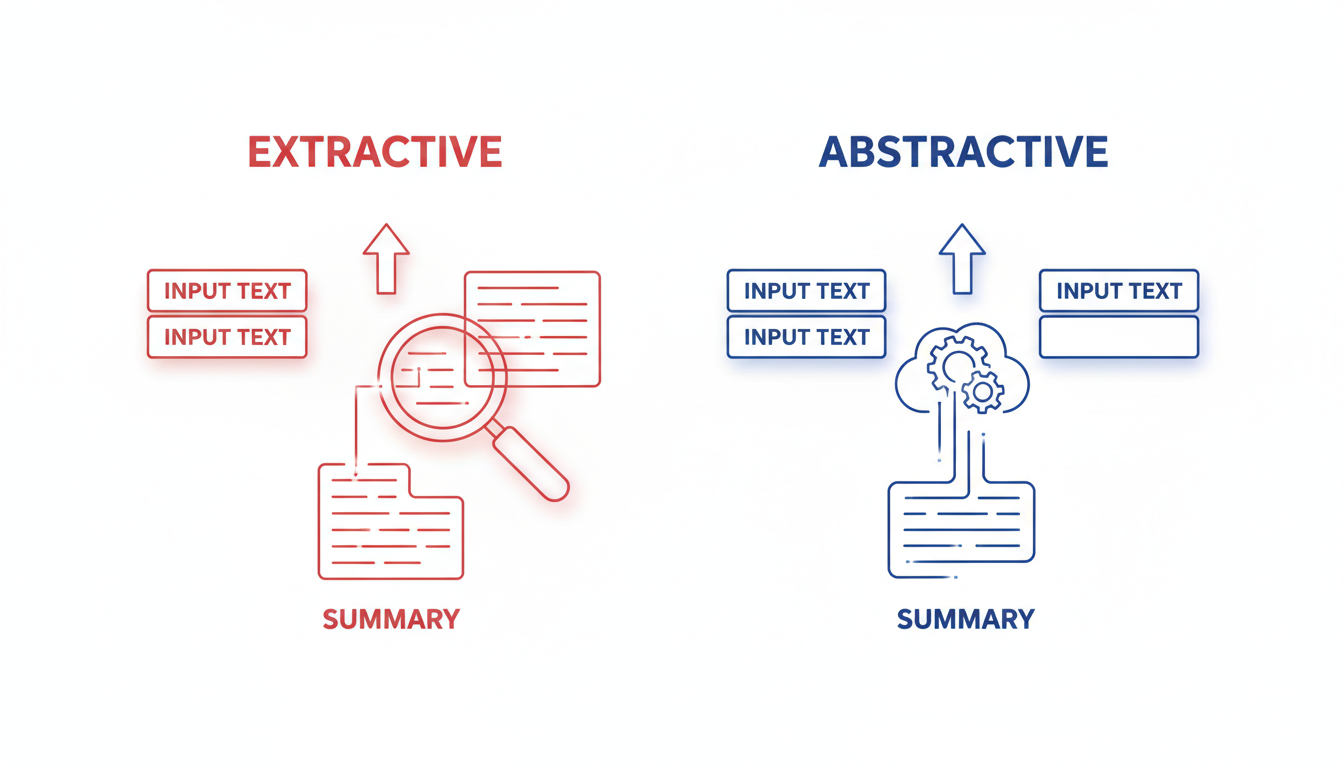
When it comes to auto summarizing meetings with AI, two primary techniques drive the process: extractive summarization and abstractive summarization. Understanding the difference between these methods will not only enhance comprehension but also ensure accuracy and reliability.
Extractive Summarization involves pulling directly from the original text. Imagine using a highlighter to pick out key phrases and sentences that capture the essence of a conversation. This method maintains original wording and is ideal for ensuring accuracy and avoiding misinterpretation. For instance, if a meeting transcript includes statements about a project deadline, extractive summarization would highlight those exact lines, preserving their integrity.
Abstractive Summarization, on the other hand, is akin to rewriting or paraphrasing the content. It leverages AI capabilities to generate a more digestible and coherent narrative, similar to how you might explain a meeting’s outcome succinctly to a colleague. This technique excels in readability and conciseness but requires robust AI models to maintain accuracy, particularly in business settings where precision is critical.
Both methods have proven effective, but the choice often depends on the desired outcome—precision or readability. Experts recommend combining these for maximum benefit: extractive for accuracy and abstractive for narrative flow (AssemblyAI).
High-quality transcription is the cornerstone of reliable summarization. A clear and accurate transcript ensures that any summarization—whether extractive or abstractive—reflects the true intent of the meeting. DeepScribe employs Whisper-powered technology to deliver 99% accuracy, handling various accents and background noise seamlessly. This foundation allows for both types of summarization to function optimally, providing dependable outputs that stakeholders can trust.
Statistics showcase the effectiveness of AI summarization tools, with accuracy rates varying between 80-95% depending on the service (Convozen). This underscores the importance of incorporating a “trust layer”—a validation process that cross-references summaries with the original transcript. Such diligence not only enhances reliability but also addresses common pitfalls like missing context or invented details.
Financially, AI-driven summarization presents a substantial return on investment. Businesses utilizing these tools report a 395% ROI, primarily by eliminating manual note-taking costs and increasing operational efficiency (Convozen).
As we delve deeper into AI-powered summarization, remember that the journey from transcript to dependable recap begins with high-quality input. The combined strength of extractive precision and abstractive readability offers a robust solution for transforming meetings into valuable, actionable insights.
Step-by-Step Workflow for Reliable Meeting Summaries
Let's dive into creating dependable meeting summaries using AI, ensuring results that not only capture what was said but become actionable across your organization. Our step-by-step workflow focuses on three essential stages: Capture, Summarize, and Validate/Export. Each stage is crucial in transforming a meandering meeting dialogue into a crisp, actionable summary that your team can trust.
Stage 1: Capture - Ensuring Transcription Quality
Key Insight: The foundation of any trustworthy AI-generated summary is a high-quality transcript. Without a clear and accurate transcript, even the most sophisticated AI will struggle to produce an accurate summary.
To kick off genuine meeting intelligence, invest in capturing a precise and speaker-labeled transcript. Companies like DeepScribe leverage AI models like OpenAI's Whisper, promising 99% accuracy even in challenging audio conditions, cutting through accents, background noise, and industry-specific lingo.
Done means:
- Clear audio quality: Ensure microphones are positioned well, and consider using noise-cancellation hardware or software.
- Speaker labeling: Each participant should be identifiable to accurately attribute decisions and action items. DeepScribe, for instance, provides speaker identification to eliminate confusion.
Stage 2: Summarize - Balancing Precision and Readability
Key Insight: Effective summaries are not mere reflections of the transcript. They require a blend of precision (extractive summarization) and readability (abstractive summarization).
Extractive summarization involves pulling out the most critical lines verbatim from the transcript. This is your "highlight reel," showing exact words for clarity and precision.
Abstractive summarization, on the other hand, rewrites content to convey the same meaning in a more concise and accessible way—suitable for creating concise, executive summaries.
Industry recommendation emphasizes this dual approach for business communications (AssemblyAI, 2023). Implementing both methods ensures that summaries are not just faithful representations of the transcript but also easy to digest and actionable.
Done means:
- Key points highlighted: Vital decisions, topics, and insights need to be succinctly noted.
- Readable narrative: The summary should make sense to someone who wasn't present in the meeting, offering context where necessary.
Stage 3: Validate/Export - Using a Checklist for Completeness
Key Insight: Verification is indispensable—without it, AI summaries may confidently present inaccuracies. By adopting a rigorous validation checklist, your team ensures every summary is both accurate and complete.
Introduce a Summary Trust Score validation rubric to map every decision and action back to transcript evidence, complete with timestamps and speaker attribution. The process involves double-checking essential elements like decisions, owners, deadlines, and any unresolved questions, as these components are fundamental in fostering team accountability and follow-through.
Implement a question-based prompt pack that digs into key themes—like risks and blockers—to ensure nothing is missed.
Done means:
- Every highlighted decision or task in the summary is traceable back to the transcript.
- Deadlines and ownership of tasks are clearly documented.
- Open loops or ambiguous decisions are cataloged with follow-up actions.
Here's a validation checklist you might use:
| Validation Item | Description | Status |
|---|---|---|
| Decision Attribution | Are all decisions tied to a speaker? | ![checkbox] |
| Action Items Clarified | Do action items have clear owners? | ![checkbox] |
| Deadlines Specified | Are completion dates included for tasks? | ![checkbox] |
| Unresolved Questions | Are open loops noted for future meetings? | ![checkbox] |
Export Formats: Once validated, export the summarized content in the format best suited for your team's workflow. DeepScribe offers multiple formats like DOCX, PDF, and SRT/VTT for easy ingestion into collaborative tools or documentation systems.
Takeaway: A robust QA process elevates AI summaries from mere documentation to actionable intelligence.
"AI meeting summaries are good but not perfect—80–95% accurate. The right workflow and quality checks make them dependable."
By applying this workflow, you create a seamless transformation process where the raw transcript becomes not just a summary, but a strategic asset that drives decisions and accountability.
Creating a Summary Validation Checklist
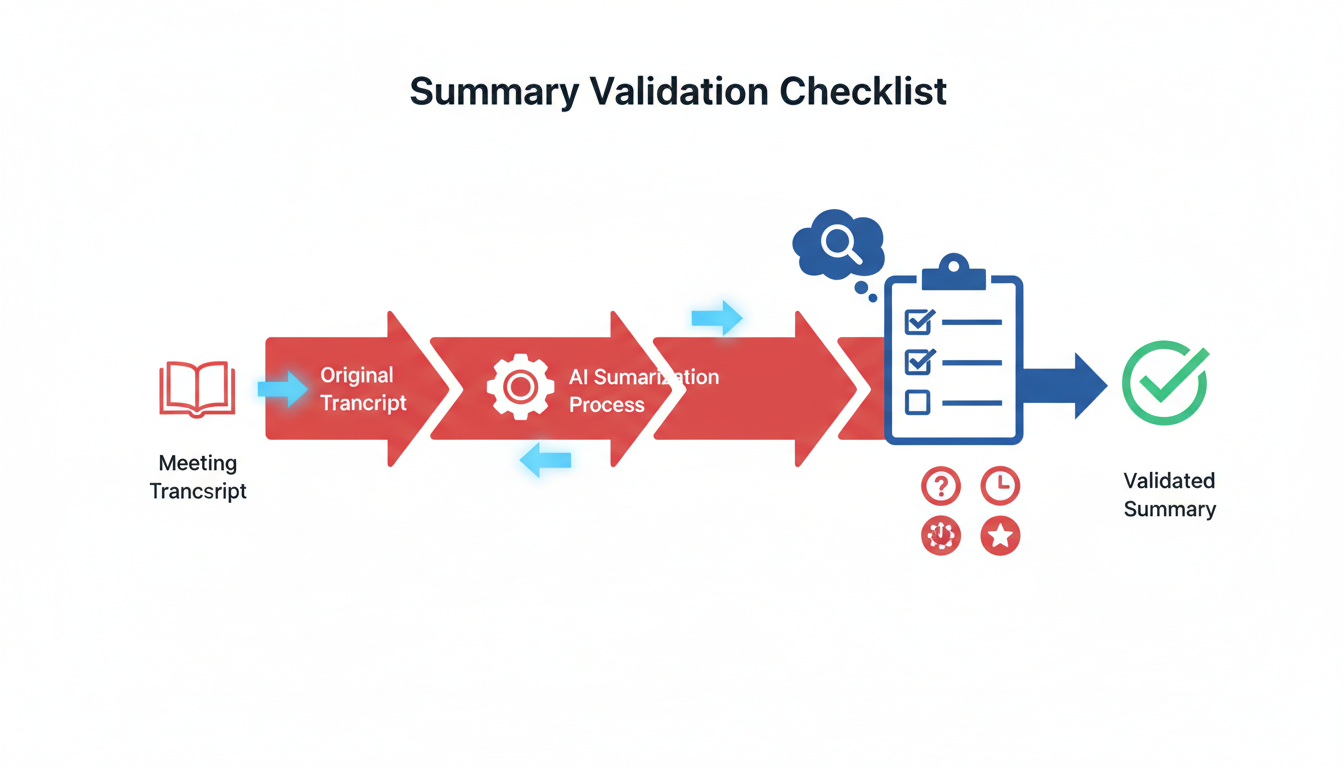
When it comes to ensuring the reliability of AI-generated meeting summaries, a well-structured Summary Validation Checklist is essential. This checklist is designed to map critical decisions and action items back to the original transcript, reinforcing their accuracy and accountability.
Mapping Decisions and Action Items
Key Insight: Every decision and action item in your summary should align perfectly with the transcript evidence. This alignment prevents misunderstandings and ensures that all parties have a clear understanding of their responsibilities.
- Decisions: Ensure each decision mentioned in the summary is traceable in the transcript. Highlight specific phrases or agreements that correspond to these decisions.
- Action Items: Clearly map each action item to the relevant portion of the transcript. This includes identifying the responsible party and any mentioned deadlines.
Utilizing Timestamps and Speaker Attribution
Key Insight: Timestamps and accurate speaker attribution are crucial for validation. They provide a clear path from the summary back to the transcript.
- Timestamps: Use timestamps to pinpoint where in the meeting a decision or action item was discussed. This reference acts as a checkpoint for verification.
- Speaker Attribution: Ensure each contribution is correctly labeled with the speaker's name. This avoids mix-ups about who is responsible for follow-through.
Introducing the ‘Summary Trust Score’ Rubric
Key Insight: Implementing a ‘Summary Trust Score’ rubric transforms your summary into a dependable resource. This rubric grades the accuracy and completeness of the summary against specific criteria.
- Completion: Assess whether all decisions and action items are covered.
- Evidence Mapping: Validate that each point in the summary corresponds to explicit evidence in the transcript.
- Speaker Accuracy: Verify that speaker contributions are accurately attributed, addressing potential confusion from crosstalk or ambiguous references.
Expert Insight: “AI summaries achieve 80-95% accuracy. However, implementing a robust validation layer significantly enhances their reliability.” — Adapted from industry research.
By creating a rigorous checklist, you not only enhance the reliability of your meeting recaps but also build trust in AI-generated outputs. Tools like DeepScribe simplify this process with speaker-labeled transcripts and easy export formats, ensuring your meeting summaries are always audit-ready.
Using Question-Based AI Prompts for Effective Summaries
Crafting question-based AI prompts focuses your meeting summaries on the essentials: decisions, ownership, and deadlines. This method ensures each summary element can be traced back to the original transcript, preventing misunderstandings.
Focus on Key Decisions
Start your prompts by asking direct questions about decisions made during the meeting. For instance, "What were the key decisions taken?" helps the AI pinpoint critical determinations. This approach aligns summaries with the conversation's actual flow, minimizing errors commonly seen when AI "hallucinates" information. With AI meeting summary tools like DeepScribe, the integration of such targeted prompts enhances accuracy, ensuring summaries remain faithful to the transcript.
Highlight Ownership and Deadlines
Ownership and timelines are vital for actionable summaries. Use prompts like "Who is responsible for each action item?" or "What are the deadlines associated with these tasks?" These questions coax the AI to extract relevant details, providing clarity and accountability in meeting recaps. It's crucial for operations leads and project managers who need to ensure tasks are assigned properly and deadlines are transparent.
Key Takeaway: By integrating specific prompts about ownership and timelines, you can drastically improve the reliability of action items in AI-generated summaries.
Surface Risks and Blockers
Identifying potential obstacles is essential for proactive management. Prompts such as "Were any risks or blockers mentioned?" enable the AI to surface concerns that might otherwise be glossed over. Context-aware meeting summaries, driven by these prompts, allow team managers to address challenges before they escalate, fostering a more prepared team environment.
Utilize Context-Aware Summaries
Context is everything. Using AI that’s trained to understand the context can revolutionize your meeting summaries. For example, "In light of last meeting's goals, what changes were proposed?" prompts the AI to consider ongoing goals, which leads to summaries that reflect the dynamic nature of business discussions.
DeepScribe offers the ability to generate context-aware summaries, leveraging its speaker-labeled transcripts and advanced AI algorithms to produce actionable insights rather than generic notes. With a commitment to transcription quality and structured outputs, it’s an ideal tool for creating dependable meeting recaps that your team can trust.
Executing the Process in DeepScribe
Turning your meeting recordings into actionable insights is a breeze with DeepScribe. In this section, we’ll navigate through leveraging DeepScribe’s robust features to generate trustworthy meeting summaries and action items. We’ll also explore seamless export options for easy integration into your team's workflow.
Walkthrough of DeepScribe’s Meeting Notetaker and Transcript Upload Features
Key Insight: DeepScribe provides an intuitive experience, whether you’re using its meeting notetaker or uploading transcripts directly. This service is designed to produce highly accurate, speaker-labeled texts with minimal effort.
Meeting Notetaker: Once configured to join your Zoom, Microsoft Teams, or Google Meet sessions, DeepScribe’s notetaker bot automatically logs in, captures the entire meeting, and produces a real-time transcription. This process ensures critical moments are documented, freeing you from manual note-taking.
Transcript Upload: If your meetings are pre-recorded or you prefer uploads, simply drag and drop files into DeepScribe. Supported formats include MP3, MP4, WAV, M4A, and WEBM. The platform’s high-accuracy transcription engine, powered by OpenAI’s Whisper, processes these files quickly, ready to deliver actionable insights.
Done means... All speech is accurately transcribed and speakers are correctly labeled, setting the stage for generating summaries and action items.
Generating Summaries and Action Items
Key Insight: DeepScribe’s AI-driven approach crafts concise summaries and highlights action items, transforming your transcripts into manageable, effective summaries.
Automated Summaries: The AI extracts the essence of the conversation, distilling lengthy discussions into clear, concise summaries. This is where DeepScribe’s dual-output shines—utilizing extractive summarization for precision and abstractive summarization for readability.
AI-Powered Action Items: DeepScribe identifies critical action items, assigning owners and deadlines when possible. This feature helps maintain accountability and ensure follow-through, a crucial element for any project manager or operations lead.
Why it matters: AI summaries are about 80–95% accurate. DeepScribe’s attention to transcription quality lays the foundation for trusted outputs, mitigating the risk of missing key points.
Done means... Your recap includes a clear summary, a decision log, and identified action items with owners and deadlines duly noted.
Exporting as DOCX, PDF, SRT, VTT
Key Insight: With several export options, DeepScribe ensures your meeting notes integrate effortlessly into various formats suitable for documentation and further processing.
Formats Available: Depending on your subscription tier, you can export meeting notes as DOCX, PDF, SRT, or VTT. These formats support diverse needs, from creating meeting minutes to generating captions for video content.
Seamless Integration: Whether you need a printable document or a format for video captioning, DeepScribe’s exports are designed to fit seamlessly into your existing workflows, enhancing collaboration and continuity across teams.
Done means... You have an export that is ready for immediate use, be it for team distribution, project management tools, or public presentations.
Execution-ready Recap Template
DeepScribe provides a template structure that includes all the essentials: summary, decisions made, action items, deadlines, and any open loops or risks. This format ensures clarity and alignment within your team, facilitating real progress rather than just documentation.
Example Template:
- Summary: Concise overview of key points.
- Decisions: List of committed decisions with timestamps and speaker verification.
- Action Items: Tasks with assigned owners and deadlines.
- Risks/Open Questions: Noted potential challenges and queries needing resolution.
For project managers and operations leads, this structured recap is a game-changer, allowing for seamless follow-through on critical actions discussed in meetings.
By utilizing DeepScribe, you streamline the entire meeting documentation process, gaining both time savings and peace of mind knowing that your summaries are reliable and validated against the transcript evidence.
Explore how DeepScribe can revolutionize your meeting management by visiting DeepScribe.
Governance and Security Considerations
Ensuring robust privacy and security for meeting transcripts is crucial, especially when dealing with sensitive or proprietary information. DeepScribe sets a high bar with its commitment to these standards.
Privacy and Security Measures
DeepScribe employs end-to-end encryption to protect your data during transmission and storage. This means that only authorized users can access the recorded information, safeguarding against unauthorized interceptions. Moreover, automatic deletion policies ensure that audio and transcripts are removed after processing, minimizing data retention risks. This approach aligns with best practices for data privacy, reducing the chances of breaches.
Key Takeaway: Always prioritize tools offering end-to-end encryption to ensure your data remains confidential throughout the transcription process.
Additionally, DeepScribe adheres to SOC 2 Type II compliance, which guarantees that their system is properly managed, including security, availability, processing integrity, confidentiality, and privacy. This certification is vital for users in industries with stringent data protection requirements.
Retention Policies
Effective data retention policies are essential for managing information lifecycle securely. DeepScribe’s policy of deleting audio files post-processing aids in minimizing unnecessary data storage, which is crucial for compliance with regulations like GDPR. Organizations should adopt similar practices to ensure their data management strategies meet legal and ethical standards.
Expert Insight: Implementing a strict data retention policy can significantly reduce the risk of data exposure and non-compliance with privacy laws.
Tips for Organizational Adoption
To foster trust and efficient organizational adoption, transparency about your transcription tool's security practices is vital. Clearly communicate the security measures and benefits to your team to facilitate wider acceptance and standardized use. Consider creating a standardized workflow incorporating DeepScribe’s features, integrating this into your team's existing practices for a seamless transition.
- Educate stakeholders on the benefits of end-to-end encryption and SOC 2 Type II compliance.
- Develop a clear protocol for managing transcripts, ensuring they are accessed and shared only by authorized personnel.
- Regularly review and update your data privacy practices to stay aligned with evolving legal standards and technology advancements.
By focusing on security and clear governance practices, organizations can efficiently implement AI-powered transcription solutions like DeepScribe, ensuring data integrity and privacy without compromising on operational needs.
Frequently Asked Questions
Why is transcription quality crucial for AI summaries?
High-quality transcription ensures accurate speaker labeling and context, key for reliable summaries.
What is the 'Summary Trust Score'?
It's a rubric that maps each summary element back to the transcript to verify accuracy.
How does DeepScribe handle privacy?
DeepScribe uses end-to-end encryption and complies with SOC 2 Type II standards.
What export formats does DeepScribe support?
DeepScribe allows exports in DOCX, PDF, SRT, and VTT.
What do I do if my AI summary is missing key data?
Use context-aware prompts and check the transcript for missed information.
Conclusion
Incorporating AI to auto-summarize meetings is a transformative approach that enhances productivity and clarity in team communications. Here are the key takeaways:
- Prioritize Transcript Quality: High-quality transcripts form the foundation for accurate summaries.
- Use Dual-Mode Summarization: Combining extractive and abstractive methods offers a comprehensive recap.
- Validation is Key: Always compare summaries against transcripts to ensure accuracy.
- Streamline with Workflow Integration: Export summaries directly into your team's workflow for seamless updates.
With these steps, you can achieve reliable and actionable insights from your meetings. To get started, try this system with DeepScribe on your next meeting. Additionally, consider adopting a validation checklist as your team standard. Discover more about DeepScribe's offerings here.
Written by

DeepScribe Team
Content Team
The DeepScribe content team shares insights on audio transcription and AI technology.
Related Articles
Continue reading about this topic
7 Best Free AI Meeting Notes Generators (2026)
Explore top AI meeting notes tools for structured outputs and learn when upgrading to DeepScribe makes sense.

DeepScribe Team
March 6, 2026 · 24 min read · 4,784 words
7 Best Free AI Meeting Notes Generators (2026)
Explore the top free AI meeting notes generators for 2026. Learn how these tools transform meetings into actionable insights with transcripts, summaries, and exports.
DeepScribe Team
March 6, 2026 · 25 min read · 4,881 words